
Every web page you view is the result of a chain of calculations and transfers: the browser queries a server, the server executes code, the code queries a database, and the whole thing returns as HTML, CSS, JavaScript, and images. Caching is the art of not redoing this work when it has already been done. At each layer of this chain, a memorization mechanism can store the result of a costly operation and serve it again in a fraction of the original time: it is the best effort-to-gain performance lever on the entire web.
The word "cache" nevertheless covers very different realities. The browser cache, that of a CDN, that of a WordPress plugin, that of Redis, or that of MySQL store neither the same things, nor in the same place, nor for the same reasons. Confusing them leads to the two classic pitfalls: pages displaying outdated content, or servers unnecessarily recalculating what a cache layer should have retained. Understanding who caches what, where, and for how long is a prerequisite for any serious performance strategy.
In this guide, we go down the entire stack, in the order a request traverses it: the browser cache and its HTTP headers, the CDN and edge caching, reverse proxies like Varnish, WordPress plugin page caching, object caching with Redis, Memcached, and APCu, PHP's OPcache, and finally the buffer pool of MySQL and MariaDB. With, as a common thread, the distinction that structures everything: static resources and dynamic pages do not have the same caching needs.
What is web caching?
Web caching is the set of mechanisms that store the result of a costly operation to serve it again without recalculating it. It exists at each layer of the chain, from the visitor's browser all the way to the database. Each layer saves a different operation: a network transfer, a distance, a code execution, or a disk read.
The principle is always the same: keep the result of an expensive operation in a faster storage space or closer to the consumer, and serve it again as long as it remains valid. What changes from one layer to another is the nature of the saved operation. Browser cache saves network transfer. CDN saves geographical distance. Page cache saves PHP execution. Object cache saves SQL queries. OPcache saves code compilation. Buffer pool saves disk reads. Put together, these layers form a cascade where each level protects the one below it: the higher a request is intercepted, the less it costs.
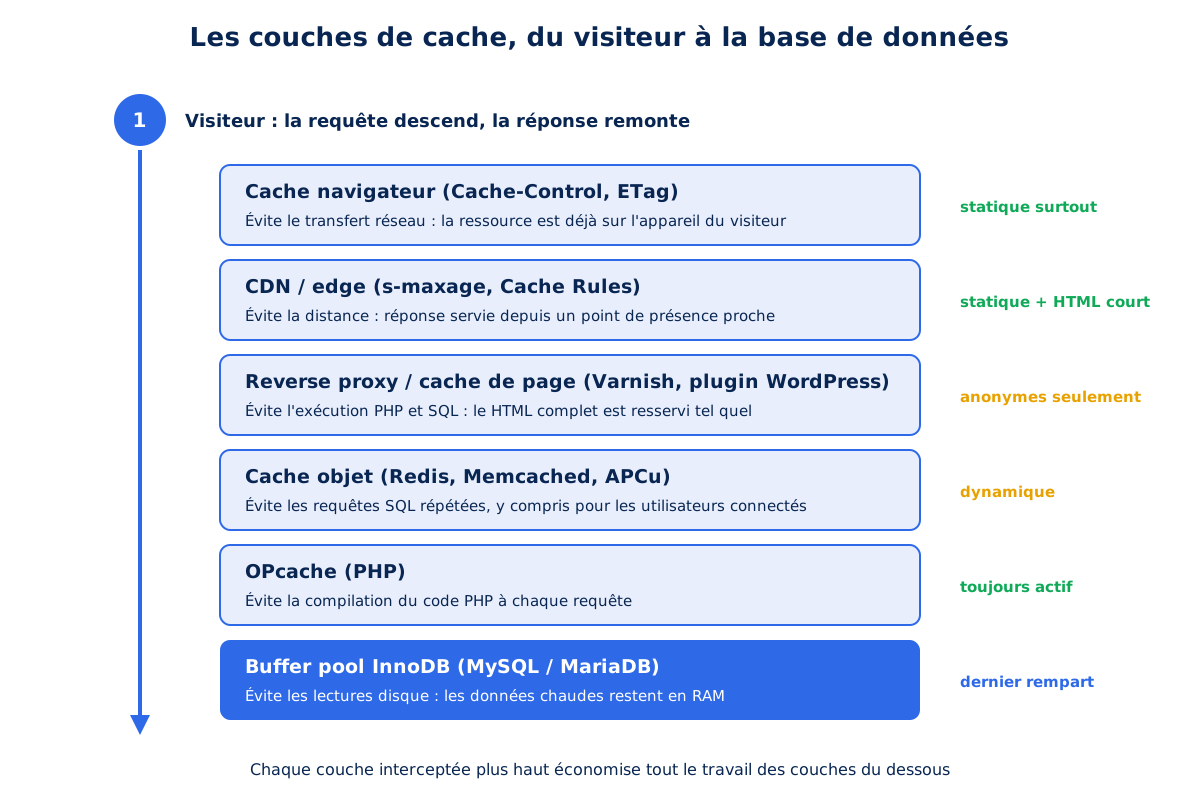
This cascade has a counterpart: each cache introduces a risk of serving stale data. All cache discipline consists of arbitrating between freshness and savings, and this arbitration depends entirely on the nature of the content. A versioned stylesheet can be kept for a year without risk: if it changes, its URL also changes. A product page with real-time stock, however, tolerates only a few seconds of delay. This is why the first question to ask about any resource is not "how long to cache it", but "is it static or dynamic, and what makes it stale?".
Static resources (CSS, JavaScript, fonts, images, SVG) are identical for all visitors and change with deployments. Dynamic pages (generated HTML, API responses, feeds) can vary depending on the user, their session, their cookies, and change with content. The former call for long and aggressive cache durations, the latter for short, conditional, or even null durations. Each of the layers we will go through applies this distinction in its own way, starting with the one closest to the visitor: their own browser.
How does browser caching work ?
Browser cache stores already downloaded resources on the visitor's device, to reuse them without a new network request. Its lifespan is controlled by the Cache-Control header sent by the server, and its validity is checked by the ETag. It is the most cost-effective cache of all, as it completely eliminates the round trip.
The browser's HTTP cache is the most cost-effective of all: a resource served from the visitor's disk or memory costs zero network bytes and zero server milliseconds of latency. It is also the only layer that you control only indirectly, through the headers your server sends. The entire mechanism is specified by RFC 9111, and it essentially relies on two headers: Cache-Control for lifespan, ETag for revalidation.
Cache-Control, the grammar of freshness
The Cache-Control header combines directives, each of which answers a specific question: who is allowed to store the response, for how long, and what to do upon expiration. The most important ones can be counted on one hand.
max-age sets the freshness duration in seconds for all caches. s-maxage sets a duration specific to shared caches (CDN, proxies), ignored by the browser. public and private allow or disallow shared cache storage. no-cache allows storage but requires revalidation on each use. no-store prohibits all storage. The distinction between these last two is crucial: no-cache revalidates, no-store prohibits all storage, and confusing them is costly.
# Ressource statique versionnée : cache long et ferme
Cache-Control: public, max-age=31536000, immutable

# HTML : stockable mais revalidé à chaque affichage
Cache-Control: max-age=0, must-revalidate

# Page personnalisée : navigateur seulement, jamais les caches partagés
Cache-Control: private, max-age=0, must-revalidate

# Donnée sensible : aucun stockage nulle part
Cache-Control: no-store| Directive | Effect | Who applies it | Use case |
|---|---|---|---|
max-age=N | Freshness duration in seconds | All caches | Basis of any policy |
s-maxage=N | Duration specific to shared caches | CDN, reverse proxy | Shared HTML for a few seconds |
public / private | Allows or disallows shared cache | CDN, reverse proxy | Anonymous pages / logged-in pages |
no-cache | Storage allowed, revalidation required | All caches | Content that changes without notice |
no-store | No storage anywhere | All caches | Sensitive data only |
immutable | Never revalidate | Browser | Assets versioned by hash |
stale-while-revalidate=N | Serves stale, refreshes in background | Shared caches | Editorial HTML |
Two confusions constantly arise in the configurations we audit. The first contrasts no-cache and no-store: the former allows storage by imposing a check, the latter prohibits all storage. Setting no-store on HTML disables the bfcache, and thus navigation using the back and forward buttons, for a most often negligible privacy gain.
The second confuses max-age and s-maxage. Serving max-age=600 on HTML imposes ten minutes of cache on the visitor's browser, which will therefore see frozen content even after your publication. The right combination separates the two audiences: systematic revalidation on the browser side, short but shared freshness on the CDN side.
A little-known pitfall is worth pointing out: a response served without any cache headers is not excluded from the cache. The browser then applies a heuristic cache, inferring a lifespan from the last modified date. The behavior becomes unpredictable and differs from one browser to another: visitors may see an outdated version without anything in your configuration explaining it. The rule is therefore simple: every resource must have an explicit cache policy, even if that policy is "do not cache".
ETag and conditional revalidation
When a resource expires, not all is lost. If the response carried an ETag header (a content fingerprint) or Last-Modified, the browser does not re-download the file: it sends a conditional request with If-None-Match or If-Modified-Since. If the content has not changed, the server responds 304 Not Modified, without a body: a few hundred bytes instead of the full file. The combination of a reasonable max-age and an ETag constitutes what we call a strong cache configuration: the retention period is controlled, and expiration results in an almost free check rather than a re-download.
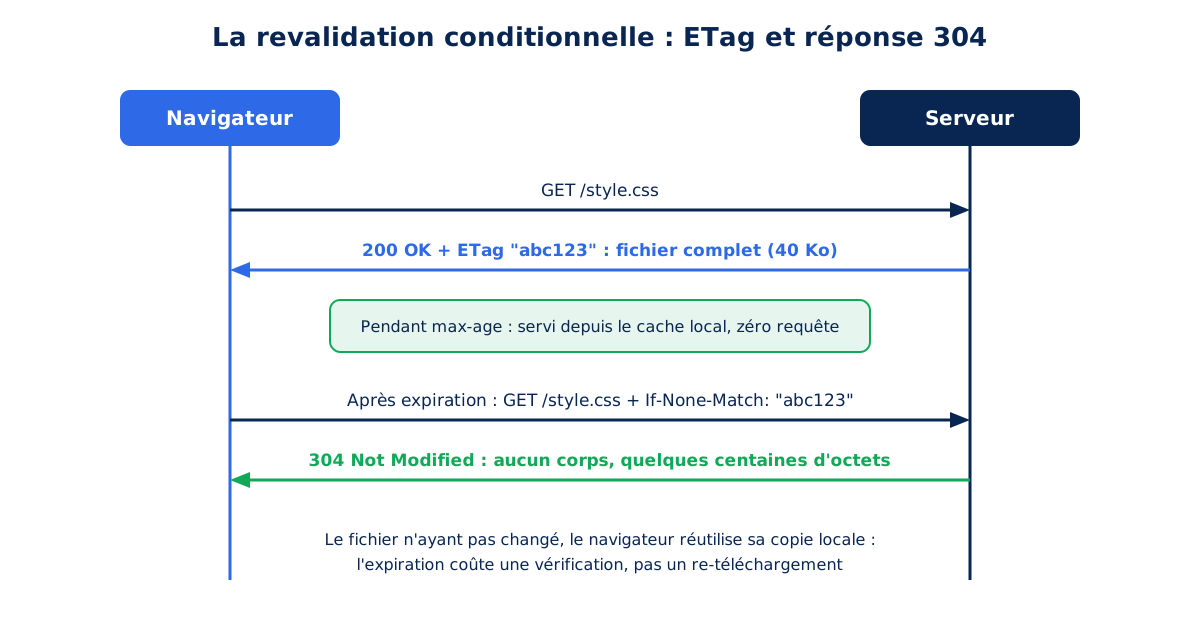
Conversely, weak configurations (no headers at all, a single Expires, or a max-age without a validator) leave room for browser interpretation and cause unnecessary re-downloads. During our audits, we systematically check the headers of the heaviest resources on the page: the main CSS, the JavaScript bundle, the LCP image, and the main font. A max-age=0 or no-store overlooked on one of them nullifies all the benefit of the browser cache on repeat visits, precisely where it should shine.
Three policies for three families of resources
The static versus dynamic distinction translates here into three typical policies. For versioned resources (a hash in the filename, like app.4f8d9.js), the cache can be maximal: one year, with the immutable directive which tells browsers that support it, Firefox and Safari according to MDN, to never revalidate as long as the resource is fresh. For unversioned static resources (logo, favicon), an intermediate thirty-day cache with ETag offers a good compromise.
For HTML, finally, the correct policy is a short or zero cache, but never no-store: this directive disables the browser's back/forward cache, the mechanism that makes navigation using the back and forward buttons instantaneous, as documented by web.dev.
<IfModule mod_headers.c>
    # Assets versionnés : un an, immutable
    <FilesMatch "\.(css|js|woff2|svg)$">
        Header set Cache-Control "public, max-age=31536000, immutable"
    </FilesMatch>

    # Images : un mois, revalidation ensuite
    <FilesMatch "\.(jpg|jpeg|png|webp|avif)$">
        Header set Cache-Control "public, max-age=2592000"
    </FilesMatch>

    # HTML : revalidation systématique, compatible bfcache
    <FilesMatch "\.(html|php)$">
        Header unset Cache-Control
        Header always set Cache-Control "max-age=0, must-revalidate"
    </FilesMatch>
</IfModule>
These headers control the browser behavior of each visitor. They do not yet address the issue of distance: between a server in Paris and a visitor in Montreal, even a perfectly cached resource will have to cross an ocean on the first load. This is the problem the next layer solves.
What is edge caching and what does a CDN do?
Edge caching consists of storing responses on a network of geographically distributed servers, the points of presence of a CDN, to serve them from the node closest to the visitor. The gain is twofold, in latency and server load: latency decreases with distance, and the origin server no longer sees the majority of requests.
A CDN (Content Delivery Network) places a network of points of presence distributed around the world between your visitors and your server. Each point of presence maintains its own cache: when a visitor requests a resource, the CDN serves it from the nearest node if it's there, and only goes back to your origin server if it's absent. The benefit is twofold: latency drops as physical distance drops, and your origin server is relieved of the majority of requests. We detailed the advantages and limitations of CDNs in a dedicated article; let's focus here on their caching aspect.
s-maxage: talk to shared caches without affecting the browser
Since the CDN is a shared cache, it obeys specific directives. The most useful is s-maxage, which sets the freshness duration on the CDN side independently of the max-age seen by browsers, as specified by the MDN documentation. A Cache-Control: max-age=0, s-maxage=60, must-revalidate, public header produces a subtle and valuable behavior for HTML: each browser revalidates its copy on each display, but the CDN shares the same version for sixty seconds for all visitors. On a high-traffic site, this minute of shared cache is enough to absorb entire peaks without hitting the origin server, while keeping content almost real-time.
Cache Rules: enforce a consistent policy at the edge
Modern CDNs allow overriding headers sent by the origin at the edge. On Cloudflare, Cache Rules allow you to separately define an Edge TTL (Time To Live on the Cloudflare network) and a Browser TTL (the Cache-Control rewritten to browsers). This is a valuable fallback when the origin serves faulty headers: a shared CMS that sends TTLs that are too short, or no headers at all, can be corrected with a single rule, without touching the server. A configuration we commonly deploy targets static resources by their file extension:
(http.request.uri.path.extension in {
  "css" "js" "woff" "woff2" "ttf" "svg"
  "jpg" "jpeg" "png" "webp" "avif" "gif" "ico"
  "mp4" "webm" "pdf" "zip"
})
On this scope, the rule forces cache eligibility, an Edge TTL adapted to the deployment rhythm, and possibly a Custom Cache Key. The latter addresses a very common problem on WordPress: versioning parameters like ?ver=6.4.2, added by themes and plugins, create a distinct cache entry for each URL variation and collapse the CDN hit ratio. Configuring the cache key to ignore these parameters, as allowed by the Cloudflare documentation, brings all variations back to a single entry.
The check is done in the Network tab of the DevTools, by observing the cf-cache-status header: HIT means the resource was served from the edge, MISS that it was fetched from the origin, BYPASS that the cache was circumvented. A well-configured site should serve the vast majority of its static resources with a HIT; a flood of MISS or BYPASS on CSS files or images is a sign of a configuration problem to be corrected as a priority.
stale-while-revalidate: serve quickly, refresh in the background
One last directive deserves its place in the arsenal of shared caches: stale-while-revalidate, specified by RFC 5861. It allows a cache to serve an expired response during a grace period, while revalidating it in the background with the origin. The visitor receives an immediate, slightly outdated response, and the next visitor receives the fresh version: the revalidation latency is moved out of the user's critical path.
A header like Cache-Control: s-maxage=60, stale-while-revalidate=300 thus combines one minute of strict freshness and five minutes of tolerance during which no one ever waits for the origin. For editorial HTML, where a few seconds of delay is invisible, this is one of the settings with the best risk-to-benefit ratio.
What is a reverse proxy and what is it used for?
A reverse proxy is a server placed in front of your application, which receives visitor requests, serves responses it already knows itself, and only forwards to the application those it cannot process. It returns the response before PHP starts, which eliminates the entire generation time.
Let's go back down to your infrastructure. Between the network and your application, a cache reverse proxy can be inserted: a server that receives HTTP requests, serves responses it already knows from its memory, and only forwards what it cannot serve to the application. The best-known representative of this family is Varnish, designed exclusively for this role: it keeps responses in RAM and serves them again without ever waking up PHP or the database. The principle also applies to its integrated equivalents, such as the NGINX cache module or LiteSpeed's server cache: in all cases, the request is served before your application even starts.
Varnish is configured in a dedicated language, VCL (Varnish Configuration Language), documented in the official documentation. Its default behavior perfectly illustrates the static versus dynamic boundary: a request carrying a cookie is not cached, because a cookie signals a potentially personalized response. All configuration work consists of refining this boundary, by removing cookies without application value (analytics, consent) to make anonymous pages cacheable, while preserving real sessions:
sub vcl_recv {
    # Les ressources statiques se cachent toujours, cookies ignorés
    if (req.url ~ "\.(css|js|woff2|jpg|png|webp|avif|svg)$") {
        unset req.http.Cookie;
        return (hash);
    }
    # Utilisateur WordPress connecté : ne jamais servir depuis le cache
    if (req.http.Cookie ~ "wordpress_logged_in_") {
        return (pass);
    }
    # Visiteur anonyme : retirer les cookies parasites (analytics, consentement)
    unset req.http.Cookie;
}
Varnish also adopts, on the server side, the idea of the grace period: its grace mode, described in the dedicated documentation, allows it to continue serving an expired response while the fresh version is regenerated in the background, and even to hold up in case of origin failure. A site whose backend restarts can thus continue to serve its pages without any visitor noticing: beyond speed, the cache becomes an instrument of resilience, capable of absorbing a traffic spike or an incident that the application alone would not have handled.
The invalidation question remains: when content changes, cache copies must disappear. Varnish offers targeted purge and URL pattern ban mechanisms for this, described in its user guide, which CMSs control via dedicated extensions. In practice, on managed hosting that integrates Varnish or an equivalent, this plumbing is already connected: publishing an article automatically purges the affected pages. This is one of the criteria that lead us to recommend WordPress hosting designed for performance rather than generic shared hosting where none of these layers exist.
Is your site as fast as your visitors expect?

How does a WordPress cache plugin work?
A WordPress cache plugin saves the final HTML of a page on the first visit, then serves this file to subsequent visitors without re-executing WordPress. The PHP and SQL chain is bypassed. A page that cost hundreds of milliseconds of computation now costs a few.
Not all sites have Varnish in front of their application. This is precisely the gap that WordPress caching plugins fill: WP Rocket, LiteSpeed Cache, W3 Total Cache, or WP Super Cache replicate, within WordPress, the principle of full page caching. On the first visit to a URL, the plugin lets WordPress generate the page normally, then saves the final HTML to a file on disk. On subsequent visits, this file is served directly, and the entire PHP and SQL chain is bypassed: a page that cost hundreds of milliseconds of computation now costs a few.
Technically, these plugins rely on a mechanism provided by WordPress: the WP_CACHE constant, documented in the official administration guide, which loads a advanced-cache.php file deposited by the plugin very early on. It is this file that checks if a cached copy exists and serves it before the WordPress core is loaded.
The most advanced plugins go further by writing rewrite rules directly into the web server configuration, so that the HTML file is served by Apache or NGINX without even starting the PHP interpreter. The choice of plugin depends on the context, and particularly on the server: we shared our criteria in our guide to choosing a WordPress theme, and the logic is the same for the caching ecosystem.
Logged-in users, shopping carts, private areas: the exclusions that save
Page caching has a structural limitation: it can only serve the same copy to everyone if the page is identical for everyone. A logged-in user, an e-commerce shopping cart, or a member area produce personalized pages that should never end up in shared cache. Detection relies on cookies: WordPress sets a wordpress_logged_in_ cookie after authentication, documented in the official cookie guide, and all serious caching plugins exclude requests carrying it by default. The same logic can be applied at the server level, to differentiate cache headers sent to anonymous visitors and logged-in users:
<IfModule mod_headers.c>
    SetEnvIf Cookie "wordpress_logged_in_" wp_logged_in=1
    # Anonymes : cache CDN partagé de 60 s
    Header set Cache-Control "max-age=0, s-maxage=60, must-revalidate, public"
    # Connectés : jamais de cache partagé
    Header set Cache-Control "max-age=0, must-revalidate, private" env=wp_logged_in
</IfModule>
Checking this type of configuration involves two curl -I commands, one without a cookie and the other with a dummy wordpress_logged_in_test cookie: the first should return public with the s-maxage, the second private. Finally, pay attention to a point that trips up many installations: caching plugins can issue their own Cache-Control headers via PHP on the pages they generate, and silently overwrite the server configuration. The only reliable verdict is that of the headers actually received, never that of the configuration file.
Preloading and purging: keeping the cache warm without serving stale content
Page caching operates based on two events: its purging, when content changes, and its filling, when a visitor requests a page that is not yet in the cache. Purging is now well managed by plugins: publishing or modifying an article automatically invalidates the affected URLs (the page itself, the homepage, archives).
The fill, however, deserves adjustment: without preloading, each purged page becomes slow again for the first visitor who requests it, the one who will pay the full generation cost. Serious plugins therefore offer preloading that crawls the sitemap and regenerates the cache in the background, so that no real visitor ever encounters a cold page.
This convenience comes at a cost that must be managed: overly aggressive preloading on a large site amounts to launching a full self-crawl with each purge, with the accompanying CPU load. The default settings are generally reasonable, but on sites with a high volume of pages, we limit the frequency of preloading and reserve it for high-traffic templates. The logic is the same as for the entire stack: the cache is there to smooth out the load, not to create a new one.
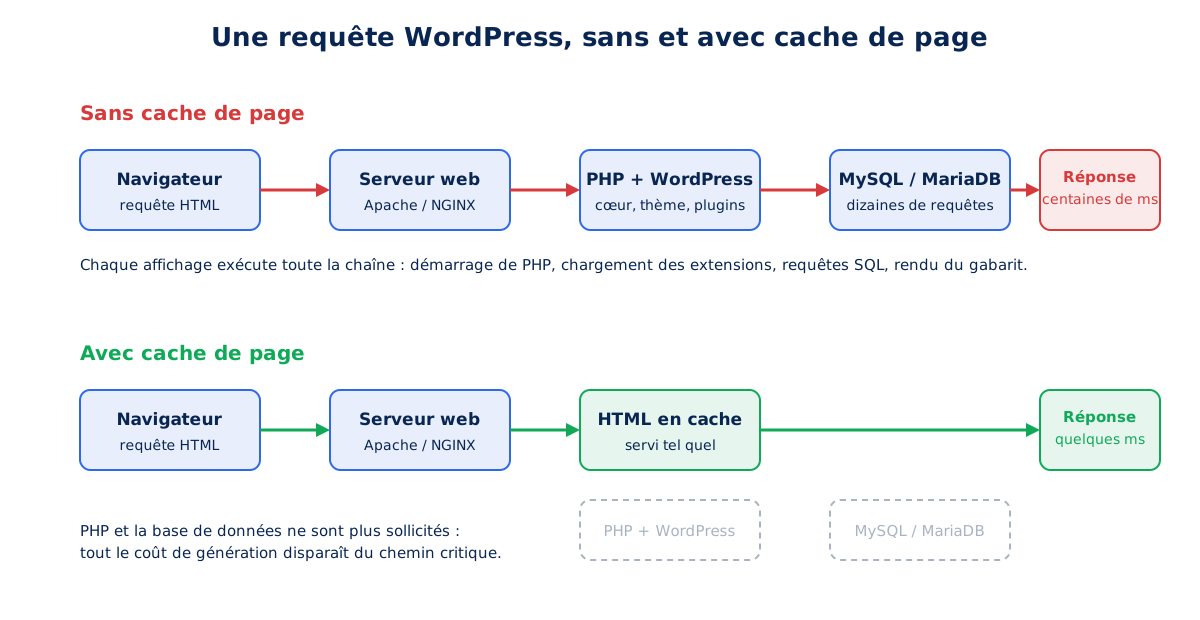
Page caching beautifully handles anonymous visitors, who make up the majority of traffic for an editorial or showcase site. But it leaves entirely unaddressed the case of pages it cannot cache: administration, logged-in users, the purchase funnel. To speed those up, you need to go down a level and tackle the generation cost itself.
What is an object cache like Redis used for?
An object cache stores the results of database queries in memory to avoid replaying them on every display. On WordPress, it makes persistent an internal mechanism that, without it, dies at the end of each query. It acts where page caching cannot: administration, logged-in users, cart.
Generating a WordPress page involves executing dozens of SQL queries: site options, content metadata, taxonomies, plugin settings. Many of these queries return the same results thousands of times a day.
WordPress natively includes an abstraction layer to store these, the WP_Object_Cache class, but with a size limit: by default, this memory only lasts for the duration of a PHP request, and everything is recalculated on the next page. Persistent object caching removes this limit by connecting this abstraction to external storage that survives from one request to another: an SQL query executed once then serves thousands of views.
The connection is made via an object-cache.php drop-in, usually installed by a dedicated plugin like Redis Object Cache, and through a few configuration constants:
// wp-config.php
define( 'WP_REDIS_HOST', '127.0.0.1' );
define( 'WP_REDIS_PORT', 6379 );
// Indispensable si plusieurs sites partagent la même instance Redis
define( 'WP_CACHE_KEY_SALT', 'monsite_' );
Three technologies share this role, with distinct profiles. Redis, the most common choice today, offers rich data structures and fine-grained visibility into what is stored. Memcached, older and intentionally minimalist, remains relevant on multi-server architectures where its simplicity is an asset.
APCu, finally, is an internal PHP memory caching module: no separate service to administer, minimal latency since everything lives within the PHP process, but a cache not shareable between multiple servers. On a single VPS hosting a site, APCu is a lean and efficient alternative to Redis; as soon as the infrastructure becomes distributed, Redis or Memcached become essential.
The effect of object caching is maximal precisely where page caching can do nothing: WordPress administration, logged-in users, WooCommerce pages with a cart. It's also what makes transients truly effective: without persistent object caching, these temporary data that plugins readily store end up in the database's options table, as explained in the Transients API documentation, and bloat this table instead of relieving the database.
Since WordPress 6.1, the Site Health tool explicitly flags the absence of persistent object caching on sites that would benefit from it, a signal formalized by the WordPress hosting manual. Verification, once the drop-in is in place, works both ways: the plugin displays its hit rate, and a tool like Query Monitor allows you to observe the drop in the number of SQL queries per page. On the administration pages of a plugin-heavy site, the switch from volatile object caching to persistent caching is immediately noticeable, without any other configuration line having changed.
What is PHP OPcache used for?
OPcache stores already compiled PHP code in shared memory as opcodes, to avoid rereading and recompiling each file on every request. It is the highest-performing cache in the server stack on a CMS like WordPress, which loads hundreds of PHP files per page.
Before executing even a single line of your site, PHP must read each source file, analyze it, and compile it into internal instructions, opcodes. Without caching, this work is redone on every request, for every file, even though the code only changes during deployments. The OPcache extension, integrated into PHP, keeps the result of this compilation in shared memory: subsequent requests directly execute the opcodes, without disk reads or compilation. On a CMS like WordPress or Prestashop, which loads hundreds of PHP files per request, this is the highest-performing cache in the entire server stack, and it's almost always active by default on recent hosting.
Active doesn't mean well-sized. Three `php.ini` directives, described in the configuration documentation, deserve systematic attention: allocated memory, interned string buffer, and the maximum number of cached files. The default values are designed for small applications; a WordPress site loaded with plugins easily exceeds them, and a saturated OPcache silently starts recompiling. Here are the values we deploy on the servers we manage:
; php.ini
opcache.memory_consumption=256
opcache.interned_strings_buffer=32
opcache.max_accelerated_files=20000

; En production stricte, on peut désactiver la revérification
; des fichiers et vider l'OPcache à chaque déploiement
; opcache.validate_timestamps=0
Since PHP 8.0, OPcache includes an additional layer, even closer to the processor core: the JIT (Just In Time) compiler, introduced in the release notes for PHP 8.0. While classic OPcache stores opcodes that the PHP interpreter still needs to execute one by one, JIT translates the most frequently used code portions into native machine instructions, executed directly by the CPU without going through the interpreter. This is the final link in the chain: after saving disk reads and compilation, we save interpretation itself.
; php.ini : activer le JIT (PHP 8.0+), en complément de l'OPcache
opcache.jit=tracing
opcache.jit_buffer_size=128M
A word of honesty is needed about what JIT reports. The official release notes place its clearest gains on intensive computing loads; however, a CMS like WordPress spends most of its time waiting for the database and I/O, not computing. On a classic web page, the JIT gain is therefore real but modest, far behind that of OPcache sizing: it's a supplement to enable once everything else is in place, not a lever to replace the rest. The tracing mode, recommended by the configuration documentation, automatically targets the code's hot loops.
OPcache, including JIT, requires no application invalidation: it refreshes itself when files change, at the frequency defined by the configuration. Monitoring it is limited to periodically checking that the allocated memory is not full and that the hit rate remains close to 100%. Once compiled code is served from memory, there is one last possible bottleneck, at the very bottom of the stack: the database itself.
How does the database cache its data?
MySQL and MariaDB store recently read table and index pages in RAM, within InnoDB's buffer pool. As long as a requested piece of data is found there, the response does not touch the disk. It is the most critical setting on the database server, and most often left at its default value.
A database spends its time reading table and index pages. InnoDB's buffer pool, the storage engine for MySQL and MariaDB, is the RAM area where these pages are stored after being read: as long as requested data is found there, the database responds from memory, without touching the disk. The MariaDB documentation describes it as the most important memory area to tune, and indicates that up to 80% of RAM can be allocated to it on a machine dedicated to the database. If undersized, it forces repeated disk reads: each query slows down, WordPress waits for the database, and server response time degrades on all uncached pages.
The problem is all the more insidious because the default value, often 128 MB, is almost always left as is, even on servers with several gigabytes of RAM. Our sizing rules are simple: 70 to 80% of RAM on a machine dedicated to the database, 40 to 50% on a VPS that also hosts the web server and PHP, never more than the available physical RAM, and no need to exceed the total size of the database. The current value can be read with a query:
-- Taille actuelle du buffer pool, en mégaoctets
SELECT @@innodb_buffer_pool_size/1024/1024;

-- Réglage, dans la section [mysqld] du fichier de configuration
-- MariaDB : /etc/mysql/mariadb.conf.d/50-server.cnf
-- MySQL   : /etc/mysql/mysql.conf.d/mysqld.cnf
-- innodb_buffer_pool_size = 2048M
A word about a red herring still very common in tutorials: the query cache, which memorized the textual result of SELECT queries, was removed from MySQL 8.0 and remains disabled by default on MariaDB due to its scaling issues, as the query cache documentation reminds us.
Highlighting it no longer makes sense: query result caching now happens one level higher, in the application object cache, and the database focuses its memory intelligence on the buffer pool. In shared hosting, this parameter is not accessible anyway: it is one of the trade-offs that structurally separate the offers, and one more reason to choose your hosting based on technical criteria rather than price.
Should static and dynamic content be cached differently?
Yes, and this is the distinction that structures the entire strategy. Static resources, identical for everyone and versioned, are cached for a long time and aggressively. Dynamic pages, which vary by user, are cached for a short time, conditionally, or not at all. Confusing the two results in either stale content or servers recalculating for nothing.
Let's recap the entire stack from the perspective that structures it: what each layer caches, for whom, and for what type of content. This table summarizes the initial settings we apply, which obviously need to be refined according to the context of each site:
| Layer | What it avoids | Static | Dynamic |
|---|---|---|---|
| Browser | Network transfer | 1 year, immutable | max-age=0, must-revalidate |
| CDN / edge | Distance and origin | Long TTL, clean cache key | Short s-maxage (0 to 60 s) |
| Varnish / page cache | PHP + SQL execution | Systematic | Anonymous only, purge on publication |
| Object cache (Redis, APCu) | Repeated SQL queries | None | Systematic, including logged-in users |
| OPcache | PHP compilation | Systematic | Systematic |
| InnoDB buffer pool | Disk reads | None | Sized according to RAM |
Reading this table vertically reveals the overall logic. For static resources, everything happens in the upper layers: the browser and CDN do the bulk of the work, and the server layers barely see them. For dynamic pages, it's the opposite: the upper layers stay out of the way to preserve freshness, and it's the lower layers, from the page cache to the buffer pool, that absorb the generation cost. A mature caching strategy is therefore not a magic bullet, but a coherent stack where each level handles what the previous one lets through.
Where to start to implement caching?
Start by measuring what is actually cached today, by examining the served headers and the hit rate of each layer. Then, enable the layer that is most missing in the chain, as it is the one that protects all the others. Each layer is enabled and then verified before moving on to the next.
Faced with this stack, the mistake would be to enable everything at once and hope for the best. Each layer is evaluated by measurement: headers actually served are read in DevTools or via curl -I, CDN hit rate in its analytics, page cache efficiency in server response time, object cache and buffer pool efficiency in database metrics.
The most profitable starting point depends on the site's profile: an editorial site with anonymous traffic will first benefit from page caching and CDN, while a store with logged-in users will first benefit from object caching and the buffer pool. And caching doesn't exempt you from anything: a page that is slow to generate will remain slow with each expiration, and a cache only distributes a cost that is always better to reduce at the source.
This leaves the question of diagnosis: on an existing site, knowing which layer is missing, which is misconfigured, and which is overwhelming the others requires reading the entire chain, from HTTP headers to database behavior. This is precisely the scope of a web performance audit: mapping the existing caches, measuring what each one actually intercepts, and prioritizing the settings that will change your visitors' metrics. Because behind every well-tuned cache layer, there's a lower TTFB, a following LCP, and visitors who stay.