
Many website publishers consider web performance to be purely an SEO topic. This is not the case, and it goes much further than visibility in Google search results pages: user experience, conversions, hosting costs, carbon footprint, all effects detailed in our article on what web performance is and how to measure it. Today's topic is narrower and more debated: the SEO gains directly attributable to a fast website.
SEO, or natural referencing, refers to all the levers that improve a site's visibility in a search engine's organic results. Speed has been part of it since 2010, and Core Web Vitals, LCP, CLS, and INP, became its official measure in 2021. But between a documented ranking signal and a lever that gains positions, there is a gap that commercial discourse crosses too quickly. Google itself writes that a good score guarantees no position.
This article establishes what Google's documentation says exactly, where speed actually affects SEO, from crawl to Discover, and what this changes in how the subject is presented to management. If you are here, it is because you want to know if it is relevant to take care of the web performance of your sites or those of your clients for their visibility. The answer is yes, but not for the reason you were given. How does speed really enter the algorithm?
Since when does speed matter to Google?
Google announced speed as a ranking criterion in 2010 for desktop, then in 2018 for mobile. Core Web Vitals became an official signal in 2021, within the Page Experience component, and INP replaced FID on March 12, 2024. Speed has therefore been a factor for fifteen years, with a weight that has become more precise rather than increased.
A discipline long orphaned
Web performance has only been considered a discipline in its own right for about fifteen years. Previously, care was taken to have a light and fast website, considering it an extension of careful front-end development. For the older ones, those called webmasters, it was part of the job just like SEO and ergonomics: reducing the number and weight of resources, controlling third-party scripts, generating a static version of pages. Without a common framework, but with common sense.

Over the years, the web has seen the emergence of increasingly specific professions, from web designer to SEA manager, including copywriter and SEO consultant. One of the collateral damages of this specialization is web performance, which no one has championed as a discipline: neither UX designers, nor SEO specialists, nor even front-end developers wanted to hear about it. Google had to quantify it and include it in Search Console for it to find an owner within organizations.
From speed to Core Web Vitals, then to INP
While in the past we only talked about keyword density and link building, Google has progressively introduced components into its algorithm designed to estimate the quality of a page outside of any notion of authority. What better way to judge the quality of content than to put numbers on the experience visitors have in real conditions? This is how the Page Experience aspect was born, materialized by the Core Web Vitals. The latest scope change is the replacement of First Input Delay with Interaction to Next Paint, announced on web.dev by Rick Viscomi, from the Chrome team.
The big day has arrived! After years of work, we are finally ready to make Interaction to Next Paint a stable Core Web Vital metric.
Rick Viscomi, engineer on the Chrome team, in his post Interaction to Next Paint is officially a Core Web Vital, published on March 12, 2024, on web.dev
This replacement has made the measurement stricter. FID only looked at the delay of the first interaction; INP captures the worst interaction of the entire visit, up to the next paint, and third-party scripts that wake up with each click have become visible. Our guide on INP and how to optimize it details the mechanics. For SEO, the consequence is simple: a site that passed Core Web Vitals in 2023 may no longer pass them, without a single line having been changed.
Does a site's speed influence SEO?
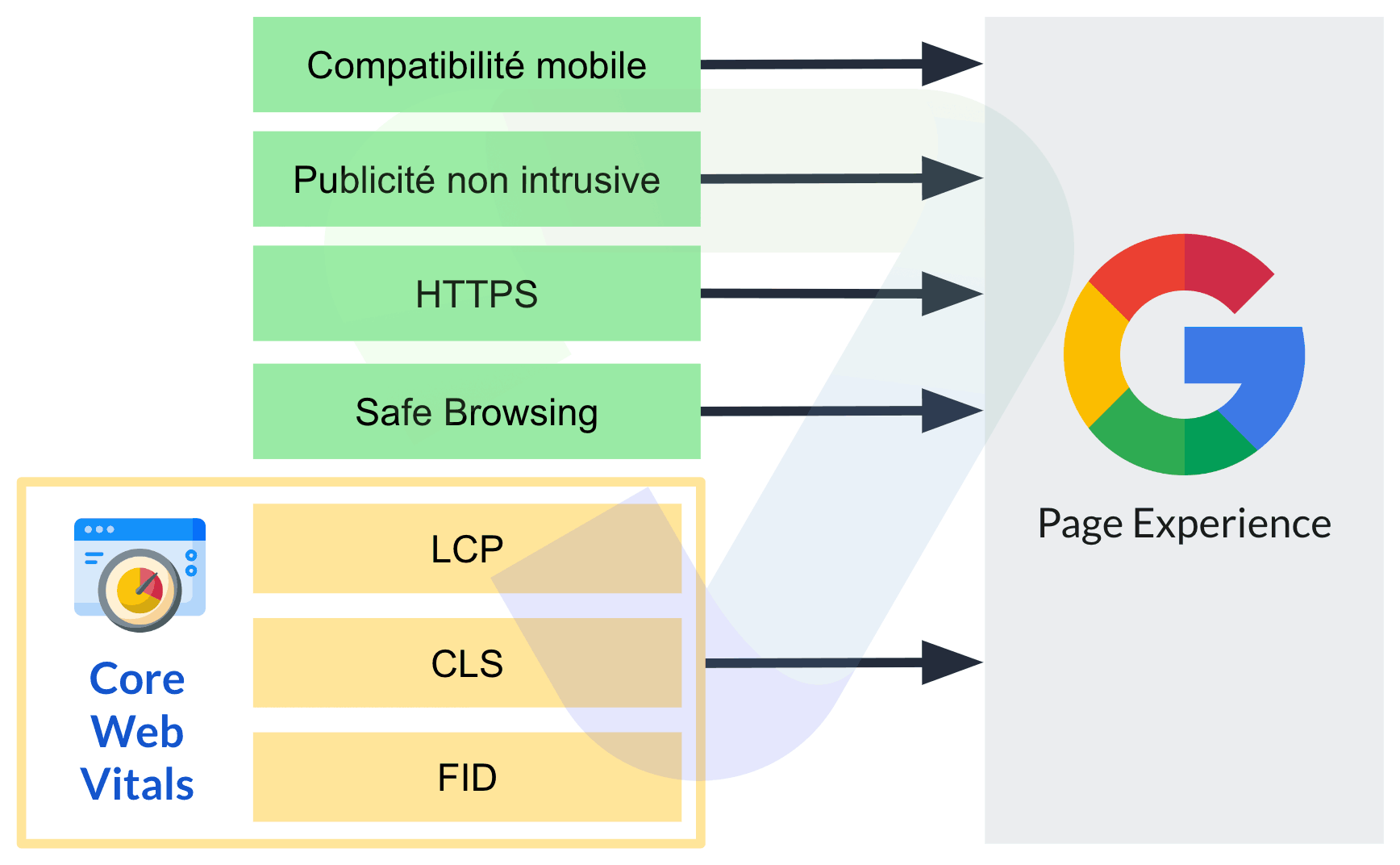
Yes, but indirectly and modestly. Google confirms in its Search Central documentation that Core Web Vitals are used by its ranking systems, while specifying that there is no single page experience signal and that a good score does not guarantee any position. Content relevance always takes precedence over speed.
What Google measures, and on what scope
With LCP, CLS, and INP, which it retrieves via Chrome users, Google can judge the experience provided by your pages, and your entire site: it's the origin-level report found in the Chrome User Experience Report. Launch a PageSpeed Insights test; the first section, Discover your users' experience, offers an Origin tab that aggregates the entire site.
This data is collected over 28 rolling days, at the 75th percentile, and only this counts for SEO, never the lab score, as our comparison PageSpeed Insights vs. Lighthouse reminds us.
Do good Core Web Vitals improve SEO?
It depends, and for once, that's the right answer. Core Web Vitals are officially taken into account in mobile and desktop rankings, but their actual weight requires caution: according to what Google says publicly, web performance acts as a tie-breaker. If two relevant content pieces come from sources of equivalent authority and send the same signals, page experience can intervene to distinguish them. It doesn't boost weak content; it prevents good content from losing to a faster equivalent.

In certain highly competitive sectors, and on certain surfaces where speed is an eligibility criterion, the impact is more pronounced. The Google Discover documentation explicitly asks for a good page experience and refers to the Page Experience aspect. Try asking a news site publisher what they think of Core Web Vitals: they will probably tell you that it sometimes keeps them up at night, because on Discover, the correlation between speed and visibility is obvious in traffic charts.
Is your site as fast as your visitors expect?

What exactly does Google say about speed and rankings?
The official documentation is more nuanced than the common discourse. The Google Search Central Page Experience page, updated in December 2025, states that Core Web Vitals are used by ranking systems, then adds that achieving good results in Search Console does not guarantee a top ranking, as page experience is not just about scores.
Three clarifications about this page are worth noting because they settle most debates. There isn’t a single signal: ranking systems look at a variety of signals that align with the overall page experience. Google always seeks to show the most relevant content, even if the page experience is poor. And for many queries, there is a lot of useful content, and it is in these cases that a good page experience can contribute to success. It’s a tie-breaker, not a progression lever: it acts when content is equivalent, and only then.
This nuance changes how the subject is presented to management. Promising rankings through performance is an untenable promise; explaining that a slow site loses the benefit of its content to an equivalent competitor is accurate and verifiable. The same page clarifies that aiming for a perfect score for SEO reasons is not necessarily a good use of one's time, and it's an argument for credibility for those who cite it rather than ignore it.
Is a fast site crawled better by Google?
Yes, and that’s the most direct effect of speed on SEO. Google’s documentation on crawl budget, updated in July 2026, indicates that if a site responds consistently and its response times, including latency and Time to First Byte, remain stable or improve, the crawl limit increases. TTFB determines the volume crawled.
The mathematical link between response time and crawled pages
Even before Page Experience, a fast site offered the assurance of better crawling by Googlebot and Bingbot, and that is still true. The crawl budget documentation describes a capacity limit that increases when the site responds quickly and stably, and decreases when latency increases, when the server returns 5xx errors or throttling signals like the 429 code. It adds that if Google can load and render pages faster, it will be able to read more content.
Low response times, measured by TTFB as detailed in our guide on Time to First Byte, therefore offer three distinct SEO advantages:
- more pages indexed, because the bot can discover and crawl more, possibly deeper into the site structure;
- fresher pages indexed, because the bot can revisit important pages more often, and content freshness counts in rankings;
- faster index updates after a change, which matters for a catalog where prices and stock change daily.
The question of indexability is clearly where the correlation between web performance and SEO is strongest: the link is not statistical, it is mechanical, written in the documentation. The stakes are nil on a twenty-page showcase site, and considerable on a high-volume site, where a new product can take weeks to be indexed by a slow site.
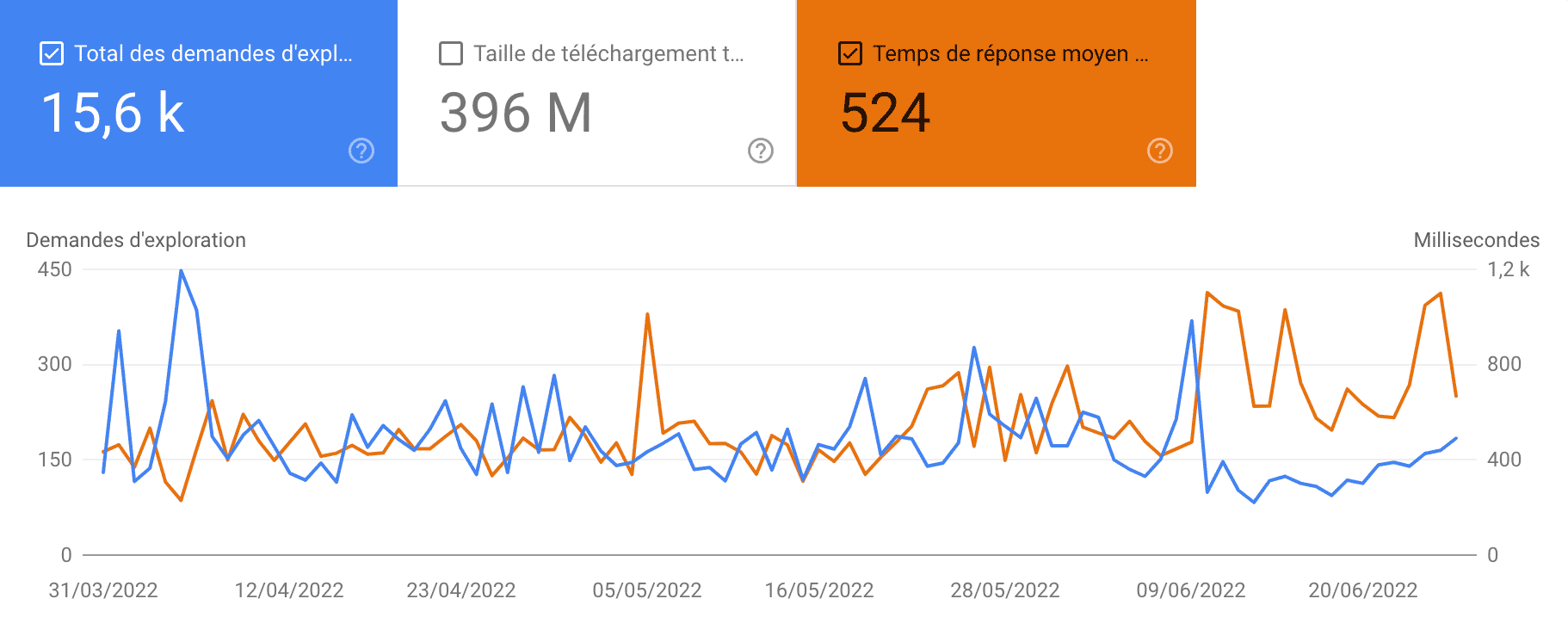
This is a point rarely addressed by SEO providers, because it relates to infrastructure and not content. It is nevertheless measured simply, in the Search Console's Crawl Stats report, where the average response time is explicitly shown, alongside the number of pages crawled per day. When the first curve goes up, the second goes down, and this is often the first sign of a hosting or cache problem, which our guide on web caching helps to interpret.
What will be the SEO impact of speed in the future?
The trend is not towards an increased weight of the signal, but towards an expanded baseline requirement. With the rise of AI-generated answers, in search engines as well as in assistants, the technical accessibility of content becomes decisive: a slow or poorly structured site is crawled less, understood less, and therefore cited less, regardless of the quality of what it publishes.
If there is a correlation between web performance and visibility, it is in Google's interest to continue refining its Page Experience component to better represent the real experience. The shift to INP is proof of this: we are no longer focusing solely on loading, but on the entire duration of page use.
With CLS, which is also calculated beyond loading over five-second windows, Google has two metrics that cover the entire visit. A site that loads heavy and intrusive ads will not be able to bypass this measure, which will naturally appear in the Chrome User Experience Report.
The question is therefore no longer whether there is an SEO impact, but which one concerns you. For a showcase site, it's about differentiation with equivalent content, and it rarely plays a role. For a high-volume site, it's about crawling, and it plays a role every day. For a publisher who lives off Discover, it's about eligibility, and it can be lost in a single update.
Figuring out which of these three situations applies to you, before starting a project, is precisely what a web performance audit produces; the article on the cost of a fast site reminds us that this project is justified anyway by what your visitors get out of it, SEO being only the most visible benefit of a site that responds quickly.